
| Grade Level | System Requirement | Product Number |
|---|---|---|
| Grades 4-9 | Apple 128K | A345 |
| Your students are sent on a mission by a king who provides them with a special gift to carry to a great king of Africa, Askia Muhammad Toure, emperor of the Songhai people. To deliver the gift, students must traverse 16th-century Africa — and the famous city of Timbuktu — seeking information and trading along the way. Kids will learn about the history, geography, and cultures of the African continent. | ||
Introduction
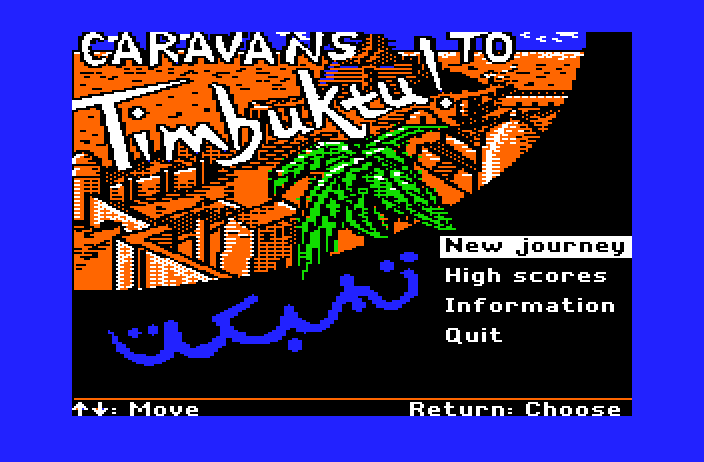
In the Caravans to Timbuktu™ software program, you take the role of the oldest child of nobles who rule a small territory. Your parents want to be certain that you can help your oldest brother rule wisely, so they are funding a journey for you to grow culturally and intellectually. You are to find and visit the “greatest king of the Bilad al-Sudan, the Country of the Blacks.” The year is 1500 C.E.
In 1500, this “greatest king” would be Askia Mohammad Touré, emperor of the Songhai people. He is the ruler of an empire that has its capital at Gao. But you do not know this; you have only heard wonderful stories of rich and powerful kingdoms deep inside West Africa. You have no idea where they are, but you have some clues. You know the names of wondrous cities, Gao and Timbuktu, and you know the approximate direction of their location.
Now you must find your way into the Sudan with a special gift to give to the magnificent king of West Africa. Your whole journey is a test to see how well you handle yourself with different kinds of people, how well you manage your finances, and how efficiently you perform required duties.
Title: Caravans to Timbuktu
Subject: Geography, African history
Grade Range: 4-9
Required Hardware: Apple II series computer with 128K RAM; color monitor recommended but not required
Learning Objectives:
- to gain an appreciation of the long history of West African people and their accomplishments, specifically:
- their expertise in crafts and in trade
- their military and political organization
- their intellectual and educational achievements
- their wide diversity as different peoples with varying cultures;
- to practice and develop reading and thinking skills while gaining historical and cultural knowledge.
- to collect, organize, record, and interpret data in order to solve the problems of performing requested tasks;
- to use basic map information;