
| Grade Level | System Requirement | Product Number |
|---|---|---|
| Grades 7-12 | Apple 128K | A277 |
| Sent back to a random point in history — from 3999 B.C. to the present — students make their way forward in time by choosing which item from various categories is the most recent. Categories include arts and literature, artifacts, headlines, conversations, and people. * Features a top-ten high-score list. * Develops sequencing skills. | ||
Introduction
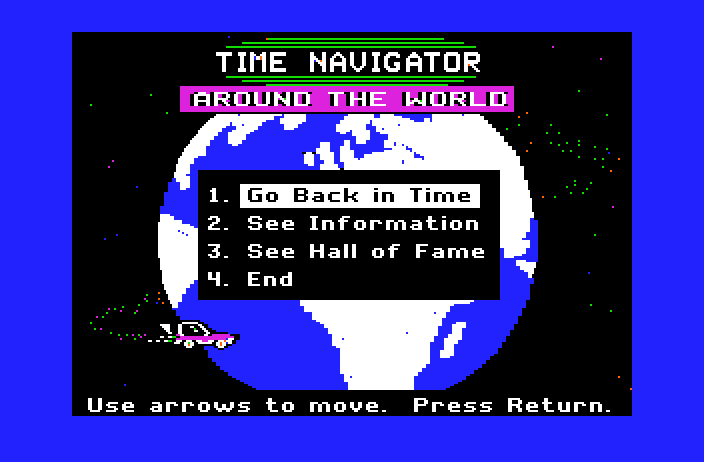
What Is Time Navigator Around the World—and Why?
Time Navigator Around the World is a simulation that helps students develop their knowledge of world history and culture. The underlying scenario of the simulation creates an environment in which time travel is possible. Students go back into the past and must “navigate” their way toward the present. Along the way in their journey they may encounter certain challenges that add excitement and variety to the experience. All the while, they’re developing their knowledge of-and, ideally, their interest in—world history.
Designed for use by high school students, Time Navigator Around the World follows in the footsteps of the original Time Navigator (No. A-247) and its “prequel,” Time Navigator Leaps Back (No. A-225). Like those two programs, Time Navigator Around the World focuses on the skill of sequencing— that is, being able to place historical events, persons, or artifacts in their correct chronological order. For example, while it’s nice for students to know that Julius Caesar lived during the first century B.C., it’s more important for them to know that he lived after the establishment of the Roman republic and before the establishment of the empire. In other words, knowledge of the correct sequence of events is more valuable than knowledge of specific dates.
When students have a good sense of the order in which events occurred, they are better equipped to understand cultural movements, themes, and paradigms; to appreciate the expectations, assumptions, and constraints that people at various periods in history lived and worked with; and to look for possible cause-and-effect relationships among historical and cultural phenomena. The concept of “cultural literacy,” as articulated by E.D. Hirsch, Jr. in his 1987 book of the same name, has generated a great deal of attention and controversy of late. Not everyone agrees with the basic premises of Hirsch’s thesis: that modern students lack a collective core of knowledge that serves as the underlying context for full, rich participation in the society and culture, and that to be “culturally literate” one must possess a particular body of knowledge that constitutes the “basics.” But in light of recent studies that reveal the unfortunate lack of knowledge young people have about a wide range of topics-including geography, history, mathematics, science, and current events—there seems to be little doubt that a very real “knowledge gap” is developing between what most educators agree students ought to know and what they really do know.
While the term “cultural literacy” per se may be new, the concept really isn’t. For many years, world history textbooks have employed, to varying degrees, an interdisciplinary approach to historical studies. Many textbooks have sought to provide students with an integrated sense of human culture, embracing history, literature, art, music, science, anthropology, and sociology. And while world history textbooks in the United States have long focused almost exclusively on “western civilization”–that is, European-based culture-more recent books have been paying much closer attention to other civilizations, including those of Asia, Africa, and the Americas before Columbus.
For instance, in discussing the 1400s, most textbooks, of course, deal with “traditional” historical events, persons, and issues, such as Columbus’s voyages of exploration, Joan of Arc, and the Spanish Inquisition. But they also devote many paragraphs to the works of such artists and writers as Leonardo da Vinci, Michelangelo, and Thomas Malory, and to such technological innovations as the movable-type printing press and ships with multiple masts. And they may describe such “non-western” events as the establishment of the Aztec Empire, the capture of Timbuktu by the Songhai Empire of West Africa, and the explorations of the great Chinese admiral Cheng Ho. In short, modern textbooks reflect the growing awareness that there’s a lot more to history than the politics and wars of Europe and North America.
To be sure, Time Navigator Around the World is a history package. But it also is very much a world cultural studies package. Students using Time Navigator Around the World will, of course, encounter wars, coronations, and revolutions. They’ll also encounter important plays like Antigone, Doctor Faustus, and King Lear. They’ll learn about ziggurats, Zoroastrianism, rogas, the turst paved streets, and the invention of paper. They’ll overhear “conversations” abou the Library at Alexandria, the Hegira of Muhammad, and the spread of slavery into the “New World.” They’ll read short synopses of such influential works of literature as Plato’s Republic, The Tale of Genji, The Thousand and One Arabian Nights, and Wuthering Heights. And they’ll hear brief excerpts of such classic musical compositions as Handel’s Messiah, Beethoven’s Ninth Symphony, and Stravinsky’s The Rite of Spring.
With Time Navigator Around the World, students will develop their skill at determining the correct sequence of a wide variety of historical and cultural events and artifacts while at the same time enriching their knowledge of their culture and gaining a greater sense of the cultural “feel” of various periods in world history.
Summary Description
In Time Navigator Around the World, students “go back in time” and then maneuver their way toward the present by selecting the most recent historical events, persons, or artifacts from groups of three. Students can choose to work with headlines, conversations, people, artifacts, or arts and literature.
Curriculum Area: Social studies; interdisciplinary*
Subject: World history
Topic: Historical sequencing
Type: Simulation
Grade Level: Junior and senior high
Classroom Use: Individual, small groups, or large group
*For information about use in non-social studies classes, see page 35.
Time Navigator Around the World includes Management Options that allow teachers to
“customize” the program to their classroom needs. See pages 19-30 for information about using Management Options.