
| Grade Level | System Requirement | Product Number |
|---|---|---|
| Grades 7-12 | Apple 128K | A278 |
| In this simulation, your students truly make the scientific inquiry process a part of their lives as they assume the roles of cell membranes. They explore cell respiration and active transport by regulating the flow of six substances into and out of the cell. Their goal is to keep a cell alive until it is mature enough to divide into two daughter cells.Increases knowledge and conceptual understanding of the equilibrium that cells maintain with their environments. Features a variety of management options. | ||
Introduction
The Living Cell is designed to help students investigate the equilibrium that cells maintain with their environment (homeostasis), cell respiration (aerobic and anaerobic), and transport (specifically active transport). The product is designed for teacher-centered demonstrations as an “electronic chalkboard” in a single-computer classroom. It is, however, also well suited for individual, small-group, or large-group student explorations in a computer lab. The programs are meant to be integrated into classroom presentations, textbook chapters, and laboratory investigations on the topics of active and passive transport, homeostasis, and aerobic and anaerobic respiration.
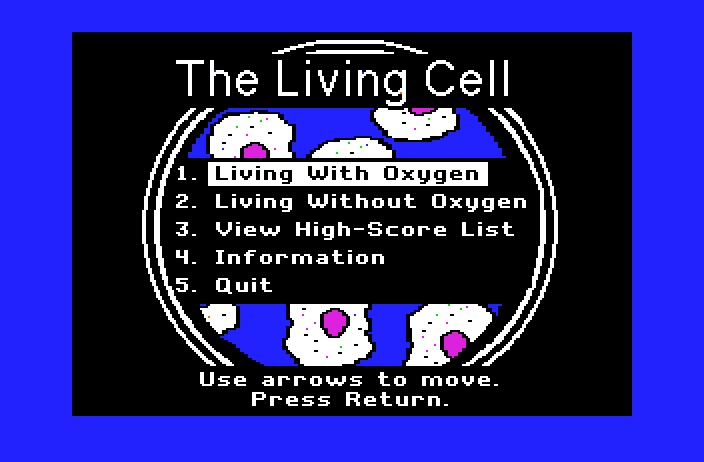
The Living Cell includes two instructional programs, Living with Oxygen and Living Without Oxygen, to enable students to increase their knowledge and conceptual understanding of the dynamic processes that take place in a living cell. Specifically, the programs simulate those functions that actively take place in the cell membrane as it attempts to maintain a dynamic equilibrium with its environment. The major focus of the simulation, active transport, is a key process that cells have at their disposal to help maintain a constant internal environment.
The Living Cell is an open-ended, unguided, learning environment in which students investigate the movement of substances into and out of the cell. Students constantly find themselves challenged to create their own models by asking “what would happen if?” questions to determine which substances to transfer and how much of them to transfer in order to keep the cell alive long enough for it to mature and divide into two daughter cells.
Living with Oxygen has three simulations. The students are required to maintain an appropriate balance of seven substances: glucose, potassium ions, sodium ions, chloride ions, water, waste, and oxygen. In Constant Environment, the cell is in a medium that does not change in response to the cell’s metabolic processes. Students must regulate seven substances in order to be successful. In Controllable Environment, the cell is in a medium that responds to the cell’s own metabolic processes. Students must regulate the substances in both the cell and the cell medium in order to be successful. In Uncontrollable Environment, the cell is in a sealed medium that responds to the cell’s own metabolic processes. Students find that they can regulate the substances in the cell, but they cannot regulate the medium the cell is in. Success in this simulation is measured in terms of efficiency, that is, the number of generations that remain alive.
Living Without Oxygen enables you to engage students in the problem-solving processes inherent in keeping a cell alive in an anaerobic environment. The simulation assumes that the cell lives in an unchanging environment (medium). The students are required to maintain an appropriate balance of six substances: glucose, potassium ions, sodium ions, chloride ions, water, and waste.
It is assumed that students will receive preparation before and guidance while using The Living Cell. This product is designed to emphasize and support the use of science process skills as well as to provide a channel for learning and understanding recommended basic concepts and principles. The goal is that these programs will either lead to or follow from student-centered laboratory investigations dealing with cellular processes, especially the movement of substances across a membrane and aerobic and anaerobic respiration. Thus, while the product is firmly grounded in recommended content, it also supports a strong process orientation.
Manual
Not available yet (In Production)