
| Grade Level | System Requirement | Product Number |
|---|---|---|
| Grades 3-6 | Apple 128K | A217 |
| Beginning with a plowed tract of land, students can select and place up to nine different plants on the land and observe changes over time. The plants’ growth, interaction, and reproduction provide valuable lessons on the principles of plant succession. Kids then use these lessons to keep certain kinds of plants on the land for a given period. | ||
Introduction
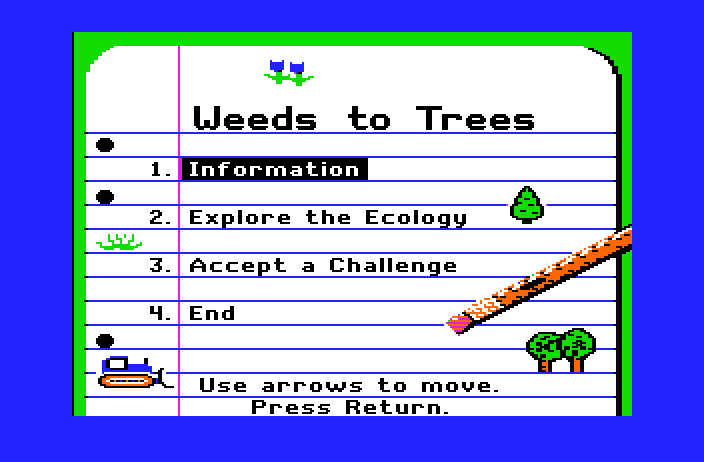
Weeds to Trees is a discovery-learning simulation that capitalizes on the natural curiosity of students and encourages them to use their curiosity while developing appropriate scientific process skills or thinking skills and to learn appropriate basic scientific content.
Weeds to Trees is part of MECC’s Science Inquiry Collection. Like all the packages in this collection, Weeds to Trees features a strong process orientation while presenting material that is firmly anchored in the elementary and junior high school science curriculum.
In Weeds to Trees, students are challenged to discover basic principles of secondary plant succession as applied to an imaginary tract of land. Their task is to determine the process by which a set of plants will colonize a plowed tract of land. For a brief description of succession, see “Background Information” on page 37.
In this simulation, students will discover the sequence of plants from early colonizers to a climax forest. Students can make this determination by selecting plants, placing them in the field, and observing the results over a period of time. As the plants reproduce, grow, and interact with each other, students carefully observe, record, and compare the characteristics of each kind of plant.
The information collected will enable students to draw conclusions and make predictions about the behavior of each kind of plant.
Life science concepts addressed by or related to Weeds to Trees include:
- secondary plant succession;
- plant communities;
- plant seed dispersal;
- plant competition;
- adaptation; and
- land management.
Science process skills developed by Weeds to Trees include:
- observing;
- communicating;
- comparing;
- organizing;
- relating;
- inferring;
- designing an experiment;
- and estimating.
Manual
In Production