
| Grade Level | System Requirement | Product Number |
|---|---|---|
| Grades 6-9 | Apple 48K | A128 |
| Even the simplest science experiments require planning and organization. In this package, your students design and observe their own experiments and form hypotheses while trying to determine the characteristics of imaginary organisms. As kids gain experience, they plan increasingly complex lab strategies and control more variables. | ||
Introduction
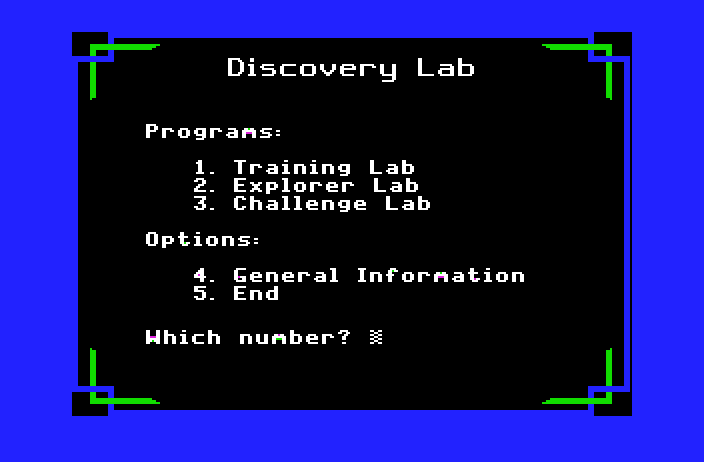
Discovery Lab is designed to introduce students to scientific processes: specifically, observation, experimental design, and hypothesis testing. Students are challenged to design experiments in order to determine the characteristics of imaginary mystery organisms. The package contains three separate labs of differing difficulty. As students progress through the labs they must control additional variables and analyze increasingly complex organisms.
Each lab contains five types of organisms and a graphical chamber where the students may design and run their experiments. Students study the characteristics of an organism by altering the conditions (variables) in a chamber. Students learn by testing and observing an organism’s behavior under the different conditions.
In TRAINING LAB students control two variables, light and temperature. Each of these variables can be set for one of two distinct conditions. The organisms in this lab always display a preference for one of the conditions.
Students working in EXPLORER LAB control five variables. Each variable in this lab can be set for one of two conditions. Most of the organisms in this lab will display a preference for one of the two conditions. In some cases, however, organisms will not have a preference for either of the conditions.
In CHALLENGE LAB students control five variables. Each variable in this lab can be set for one of three distinct conditions. Organisms in this lab may display a preference for one condition or they may not exhibit a preference for any of the conditions.
Students may continue to design experiments in a chamber until they are satisfied that they have discovered the behavior patterns of the organisms. The final results are analyzed and compared to the actual characteristics of the organisms. Possible redesigns of the experiments are suggested when the students’ findings do not match their organisms’ true characteristics.
Manual
Manual not yet available (In Production)