
| Grade Level | System Requirement | Product Number |
|---|---|---|
| Grades 5-9 | Apple 128K | A256 |
| Bluegrass Bluff, Kentucky, is the setting for a computer-simulated archeological dig. Your students “excavate” artifacts — pottery, jewelry, statuettes, and carvings — from different eras in American history. Kids dig up items from various locations, including a Civil War site, a slave plantation, an American frontier stockade, and several Native American sites. Presents a realistic, thought-provoking account of American history.Features artifacts that enable kids to put together a time line that dates back more than 10,000 years. | ||
Introduction
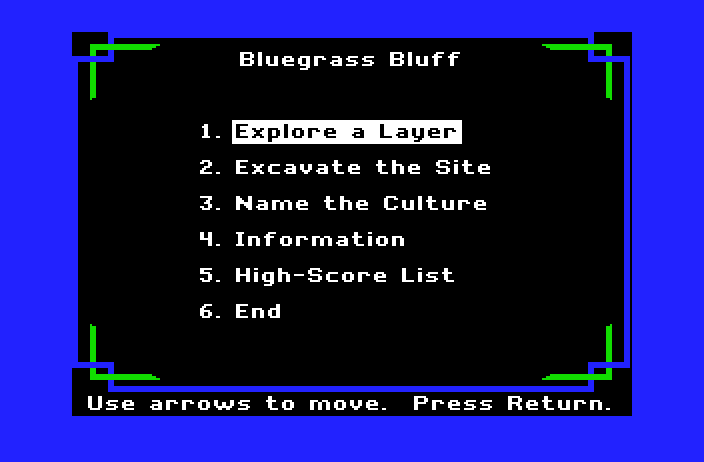
Bluegrass Bluff is a discovery-learning simulation that capitalizes on the natural inquisitiveness of students. It encourages them to use their curiosity while developing appropriate thinking skills and to learn basic archaeological and historical content. In Bluegrass Bluff, students are challenged to discover, identify, and determine the age of artifacts. As they explore each layer of artifact-filled soil, students discover a sequence of American cultures. When they discover each artifact, students should carefully observe, record, and compare the artifact’s characteristics with those of other artifacts and other cultures. The information collected enables students to draw conclusions and make predictions about artifacts heir characteristics, and where they can be found
Social studies concepts addressed or related to Bluegrass Bluff include:
- people have lived in the Americas for a very long time;
- people have lived differently throughout the ages;
- human pre-history and history are divided into units based on the different lifestyles of the people;
“high civilizations” existed not only in Mexico, Guatemala, and Peru, but also in the area that later became the United States; - wrong tool selection and digging too rapidly can easily destroy data (artifacts);
- the characteristics of artifacts and the soil in which they are found provide evidence of where and how people lived and can indicate what is called a “culture.”
Science concepts addressed by or related to Bluegrass Bluff include:
- there is a tendency for items to get covered up by dirt as time goes on;
- some items survive in the ground for a very long time while others do not;
- investigators find artifacts in layers and the process of layering is called stratification;
- the youngest artifacts are closest to the surface, and the oldest items are deepest in the ground
Science process skills developed by Bluegrass Bluff include:
- observing;
- communicating;
- comparing;
- organizing;
- relating;
- inferring;
- and estimating.