
| Grade Level | System Requirement | Product Number |
|---|---|---|
| K – Grade 2 | Apple 128K | A283 |
| The fun-loving creature Woolly leads the way in this discovery-learning simulation. With Woolly’s help, your students explore how balls with different physical characteristics behave when dropped. The perfect introduction to physical science for young children. Features three levels of difficulty.Contains a variety of management options. | ||
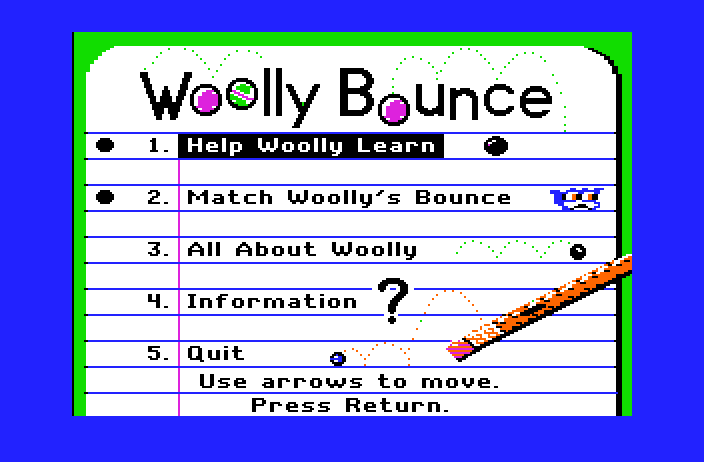
Introduction
Woolly Bounce is a discovery-learning simulation for children in kindergarten through second grade. The programs capitalize on the children’s natural curiosity and encourage them to use their curiosity while developing appropriate scientific inquiry skills and/or thinking skills. Like all products in the Science Inquiry Collection, Woolly Bounce features a strong process orientation while presenting material that is firmly anchored in the elementary science curriculum.
In Woolly Bounce, children are challenged to discover the factors that might influence the bouncing behavior of a set of balls. They observe the height the ball bounces on its first bounce and the number of times the ball bounces before coming to rest.
They can investigate up to 15 different kinds of balls, drop the ball from various heights, and select from two kinds of bouncing surfaces. As children carefully observe, record, and compare the bouncing characteristics, they will discover that each of the three factors influence the ball’s behavior. The information collected will then enable children to draw conclusions and make predictions about the balls and their bouncing characteristics.
It is assumed that the children will receive both preparation for and guidance while using these programs. Science terminology related to both physical concepts and inquiry methods are not used in these programs. Memorizing terminology and definitions is not essential for success.
The product is designed to emphasize conceptual understanding of both the science concepts and inquiry methods, which, hopefully, will lead to or follow from student-centered classroom investigations on the same or similar topics.
Physical-science concepts addressed by or related to Woolly Bounce include:
Social Learning
- Names of balls.
- Units 1-10 or 1-20 in sequence.
- Inquiry skills.
- Reading collected data.
- Recording collected data.
- Communication skills.
- Language skills.
Physical Learning
- Balls fall from an opened hand.
- Dropped balls bounce.
- The first bounce is the highest.
- Balls may bounce a number of times before coming to rest.
Logico-mathematical relationships
- The kind of ball influences the height of the first bounce and the number of bounces.
- The height of the drop influences the height of the first bounce and the number of bounces.
- The kind of surface influences the height of the first bounce and the number of bounces.
- Balls may be classified by their physical or behavioral characteristics.
Science inquiry skills developed by Woolly Bounce include:
- observing;
- communicating;
- comparing;
- organizing;
- relating;
- interring;
- estimating.
Both formal and informal investigations play an important role in a child’s development. Very often adults have very negative attitudes about children “playing in school when they should be learning.” The implication is that one cannot learn while playing.
Researchers have found, however, that about 50% of a person’s intellectual capacity has developed by the age of four and 80% by the age of eight (Bloom). If that is true, most children’s learning has taken place before their formal education has begun. Piaget has found that a child’s mind “is neither a miniature model of an adult’s mind nor an empty vessel that gradually fills up with information. It is active from infancy, as the child struggles to understand the complicated world in which he finds himself… ” (Newsweek 1980). Montessori described a child’s play as a meaningful activity. While at play, the parent or teacher can observe children’s cognitive development as well as their social, emotional, language, and physical development. Children need to become actively involved, using all their senses to find out about the world.
Woolly Bounce provides children with a playground environment in which they can become actively engaged. It enables children to playfully explore a ball’s bouncing behavior in an undirected, open-ended environment. This program is designed to give children a first-hand experience to challenge their pre-existing notions and to provoke thinking.
This environment enables children to ask and then find their own answers for those very important “what happens if?” questions. Children learn best when the problem or lesson is relevant to them. By providing them an environment they can control and where they can ask their own questions and find their own answers, the situation becomes intrinsically interesting and motivating. In addition, children have different learning styles and learning rates. This environment enables them to experiment with different problem-solving strategies and to do so at their own rate.
Time is an important factor that influences children’s involvement. It is important that children have the opportunity to become familiar with the operation and interaction of the program as well as to become immersed in the problem-solving process. The teacher should be careful to monitor the children’s progress and to interact only to focus or guide them, asking such open-ended questions as “what do you think happened?” “what happens if ..?” and “what did you do to make this happen?” Teachers should be careful not to answer the questions they are asked directly, but rather to redirect the questions back to the children: “well, what do you think caused that to happen?” It is important for children to know the correct answer; however, it is more important for them to know how to arrive at the correct answer.
Woolly Bounce, like all simulations, is deliberately limited. As a subset of reality, only specific basic factors are allowed to interact in the investigation. The value of a simulation is that it enables children to focus their attention on factors without being distracted by myriad uncontrollable factors that may influence an actual investigation. In doing so, Woolly Bounce prepares children to have a better understanding of the inquiry process when they are actually engaged in a real classroom activity.
Manual
In Production